 Index
Index


The effects of a diet or exercise program can only be monitored when you have accurate biometric data. This web page will help you calculate your Body Mass Index (BMI), Waist-to-Height ratio, percent body fat, and lean body mass. You also get an estimate of your daily calorie and protein requirements based on your level of activity. It is a good idea to record your measurements once per week to keep track of your progress. If you keep the data in a spreadsheet (e.g., MS Excel) you will be able to create charts to see trends more easily.
The number of Calories in the foods that we eat and the number of Calories that we use determines whether we will lose weight or gain weight. The extra Calories that we consume are generally stored as fat in our body. To maintain a steady weight, the number of Calories in our food must be equal the number of Calories that we use through exercise, excrete as wastes, body oils, ejaculates, menstrual flow, or use for renewal of skin, hair, nails, and other organ tissues. To lose weight, we must consume fewer Calories than our body needs so that our stored body fat is used to meet a portion our caloric needs. It is advisable to consult with your physician or dietitian before starting any diet, particularly if you take any medications.

The body requires protein to maintain the muscles and to produce hormones. Essential fatty acids are needed for cell replication and to maintain the structure of the nervous system. Therefore, any reduction of Calories must be accomplished by reducing saturated fats and carbohydrates. A diet should always provide an adequate amount of protein and essential fatty acids (EFAs). The body needs at least 15 grams of EFAs per day, which can be obtained by eating meats, fish, nuts, and flaxseed. Very low calorie diets (less than 1300 calories per day) should be avoided because they generally do not provide all the nutrients needed for good health.

The form below calculates the daily requirement of protein, the Body Mass Index, the Waist-to-Height ratio, and the percentage of body fat using the U.S. Navy Circumference Method. These metrics can help to track your progress toward achieving a healthy body structure. The method for calculating the percentage of body fat requires measurements to within 0.5 cm or 1/4 inch. Measurements should be done so that the tape measure fits snugly but does not compress the skin.
|
How to Measure
• Height - measured without shoes• Weight - taken in the morning without clothes after going to the bathroom and before eating or drinking anything • Waist (Men) - measure horizontally, at the level of the navel (Women) - measure horizontally, at the level of minimal abdominal width • Neck - measure below the larynx with the tape sloping slightly downward to the front. • Hips (Women only) - Largest horizontal circumference around the hips |
|
Level of Activity
• sedentary - Passive activities: Watching TV, working on the computer, reading, driving a car• moderate - Lively activities: One hour per day walking, swimming, jogging, tennis • active - Vigorous activities: Two hours or more per day moving furniture or playing sports |

Create a link to this web page from your blog or your web page. Copy the following HTML snippet into your blog or web page, and a hyperlink will be created using this Diet Calculator Icon. |
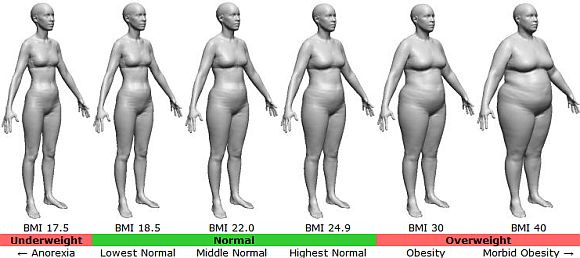
Body Mass Index (BMI) - The BMI is the ratio of your weight to the square of your height. The number is proportional to your body shape. Generally, the number is small for thin people and large for fat people. People with a BMI 25 or greater are considered overweight, unless they have a very muscular body. The BMI does not consider the fat/muscle ratio, and a healthy, muscular individual with a low percentage of body fat may be classified obese using the BMI formula. This is a well-known deficiency of the BMI formula. If your BMI is 25 or greater, and your Waist-to-Height ratio is less than 0.5 and your Percent Body Fat is in the "athlete" or "fitness" category, you are probably muscular and not fat.
| Underweight | BMI less than 18.5 |
| Normal weight | BMI 18.5 to 24.9 |
| Overweight | BMI 25 to 29.9 |
| Obese | BMI 30 or greater |

;w1.focus() "Ronnie Coleman")

Waist-to-Height Ratio - The Waist-to-Height ratio is determined by dividing the waist circumference by the height. Waist-to-Height ratios of 0.5 or greater are indicative of intra-abdominal fat for both men and women and are associated with a greater risk of cardiovascular disease. A study found that persons with a normal BMI but a large waist circumference, corresponding approximately to a Waist-to-Height ratio of 0.55, had a 20% higher mortality risk than persons with a normal waist size.[7]
Percent Body Fat - The percent body fat is calculated using the formulas developed by Hodgdon and Beckett at the Naval Health Research Center in 1984. The formulas require the measurements to be in centimeters with an accuracy of 0.5 cm. However, the form above has been adjusted to accept measurements in inches. Men and women require different methods for measuring because men accumulate fat mostly in the abdomen (the "apple" body shape or "beer belly"), while women accumulate fat in their abdomen and hips (the "pear" body shape). The equations take this into consideration.
The formula for men is:| Women | Men | |
| Essential fat | 10-12% | 2-4% |
| Athletes | 14-20% | 6-13% |
| Fitness | 21-24% | 14-17% |
| Acceptable | 25-31% | 18-25% |
| Obese | 32% or more | 26% or more |
Lean Body Mass or Fat-Free Mass - This is derived by subtracting the calculated value of body fat from the total weight.
Calories per day - The minimum number of Calories per day is calculated based on height and sex according to the guidelines of the Institute of Medicine. When the BMI is 25 or greater, the minimum number of Calories is reduced by 15% to obtain a diet that is not very severe and can be maintained for many months without adverse effects by persons with normal health. The number of Calories may need to be increased depending on the level of activity, but increasing them by more than 15% may not result in loss of weight. To lose weight, your intake of carbohydrates should be less than 60 grams per day (no more than 240 Calories) distributed throughout the day.
Grams of protein per day - This value is calculated from the maximum normal BMI, your height, and your level of activity. It corresponds to 0.8 grams of protein per Kilogram of body weight which is the Recommended Dietary Allowance (RDA) for low levels of activity, 1.1 grams for moderate activity, and 1.4 grams for vigorous activity. Other components of the diet, including essential fatty acids and carbohydrates should be proportioned to provide the minimum required Calories per day. For men and women of equal height the caloric requirements are lower for women, but the protein requirements are the same for both men and women. This means that, in general, women's diets should be richer in protein than men's diets. Any diet should always include at least the minimum amount of protein to prevent loss of muscle tissue when the caloric intake is reduced. A typical high-protein diet would derive 30% of the Calories from protein, 30% from fat, and 40% from carbohydrate. A low carbohydrate weight-loss diet generally derives 25% of the Calories from protein, 65% from fat, and 10% from carbohydrate. The tables below show that these percentages provide more than the minimum protein requirement for 2000- and 1800-calorie diets. The U.S. Government Recommended Diet is used as the basis for the "% Daily Values" that are listed on the "Nutrition Facts" labels in food products.
| Protein | Fat | Carbohydrate | |
| Calories | 30% | 30% | 40% |
| 2000 | 600 Cal | 600 Cal | 800 Cal |
| 150 g | 67 g | 200 g |
| Protein | Fat | Carbohydrate | |
| Calories | 25% | 65% | 10% |
| 2000 | 500 Cal | 1300 Cal | 200 Cal |
| 125 g | 144 g | 50 g | |
| 1800 | 450 Cal | 1170 Cal | 180 Cal |
| 113 g | 130 g | 45 g | |
| Protein | Fat | Carbohydrate | |
| Calories | 15% | 30% | 55% |
| 2000 | 300 Cal | 600 Cal | 1100 Cal |
| 75 g | 67 g | 275 g |
Eating right and exercising regularly is part of a healthy lifestyle. Take vacations and learn to relax after work to avoid stress. Learn to laugh more often. Studies have shown a correlation between laughter and health, so when you are feeling a little under the weather, do something that makes you laugh.





