 Index
Index


Astronomical and geological evidence indicates that the Universe is approximately 13,820 million years old[42], and our solar system is about 4,567 million years old. Earth's Moon formed 4,450 million years ago, just 50 million years after the Earth's formation.
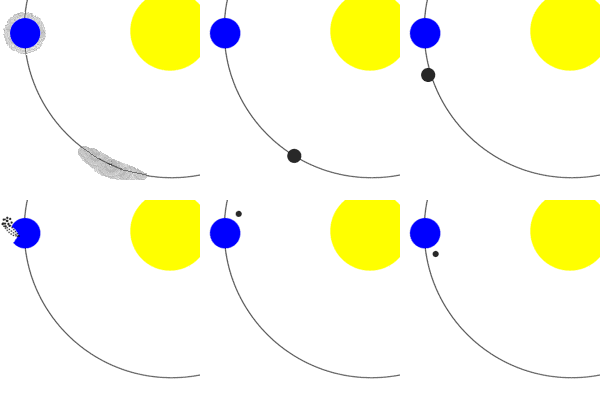
Because the composition of the rocks retrieved from the Moon by the Apollo missions is very similar to rocks from the Earth, it is thought that the Moon formed as a result of a collision between the young Earth and a Mars-sized body, sometimes called Theia, which accreted at a Lagrangian point 60° ahead or behind the Earth. A cataclysmic meteorite bombardment (the Late Heavy Bombardment) of the Moon and the Earth 3,900 million years ago is thought to have been caused by impacts of planetesimals which were originally beyond the Earth, but whose orbits were destabilized by the migration of Jupiter and Saturn during the formation of the solar system. The Mars Reconnaissance Orbiter and the Mars Global Surveyor have found evidence that the Borealis basin in the northern hemisphere of Mars may have been created by a colossal impact with an object 2,000 kilometers in diameter at the time of the Late Heavy Bombardment.[20]
Approximately 4,000 million years ago, the earth was cool enough for land masses to form. The supercontinent Rodinia was formed about 1100 million years ago, and it broke into several pieces that drifted apart 750 million years ago. Those pieces came back together about 600 million years ago, forming the Pan-African mountains in a new supercontinent called Pannotia. Pannotia started breaking up 550 million years ago to form Laurasia and Gondwana. Laurasia included what are now North America, Europe, Siberia, and Greenland. Gondwana included what is now India, Africa, South America, and Antarctica. Laurasia and Gondwana rejoined approximately 275 million years ago to form the supercontinent Pangea. The break up of Pangea, which still goes on today, has contributed to the formation of the Atlantic Ocean.
| (mya = million years ago) The times are approximate and may vary by a few million years. |
|
Precambrian Time (4567 to 542 mya) |
||
|---|---|---|
| Hadean Eon (4567 to 4000 mya) | ||

|
- 4650 mya: Formation of chondrules in the Solar Nebula - 4567 mya: Formation of the Solar System Sun was only 70% as bright as today. - 4500 mya: Formation of the Earth.  Formation of the Moon Formation of the Moon- 4450 mya: The Moon accretes from fragments of a collision between the Earth and a planetoid; Moon's orbit is beyond 64,000 km from the Earth.[33] Earth day is 7 hours long[34] - Earth's original hydrogen and helium atmosphere escapes Earth's gravity. - 4455 mya: Tidal locking causes one side of the Moon to face the Earth permanently.[30] - 4280 mya: Water started condensing in liquid form. - 3900 mya: Cataclysmic meteorite bombardment. The Moon is 282,000 km from Earth.[34] Earth day is 14.4 hours long[34] - Earth's atmosphere becomes mostly carbon dioxide, water vapor, methane, and ammonia. - Formation of carbonate minerals starts reducing atmospheric carbon dioxide. - There is no geologic record for the Hadean Eon. |
|
| Archean Eon (4000 to 2500 mya) | ||

|
Eoarchean Era (4000 to 3600 mya)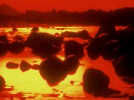 - 4000 mya: The Earth's crust cooled and solidified. - Atmospheric pressure ranged from 100 to 10 bar. - Earth day is 15 hours long Paleoarchean Era (3600 to 3200 mya) Start of Plate Tectonics - 3600 mya: Formation of first supercontinent Vaalbara. - 3500 mya: Monocellular life started (Prokaryotes). First known oxygen-producing bacteria: 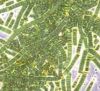 cyanobacteria (blue-green algae) form stromatolites  - Oldest unambiguous microfossils date from this era. Mesoarchean Era (3200 to 2800 mya) - 3000 mya: Atmosphere has 75% nitrogen, 15% carbon dioxide. - Sun brightens to 80% of current level. - 2900 mya: Pongola glaciation occurred. Neoarchean Era (2800 to 2500 mya) - 2800 mya: Break up of supercontinent Vaalbara. - Oldest record of Earth's magnetic field. - 2700 mya: Supercontinent Kenorland formed. - Photosynthetic organisms proliferate. |
|
| Proterozoic Eon (2500 to 542 mya) | ||


|
Paleoproterozoic Era (2500 to 1600 mya) Siderian Period (2500 to 2300 mya) - Stable continents first appeared. - 2500 mya: First free oxygen is found in the oceans and atmosphere.  Banded Iron Formations Banded Iron Formations- 2400 mya: Great Oxidation Event, also called the Oxygen Catastrophe. Oxidation precipitates dissolved iron creating banded iron formations.[14] Anaerobic organisms are poisoned by oxygen. - 2400 mya: Start of Huronian ice age Rhyacian Period (2300 to 2050 mya) - 2200 mya: Organisms with mitochondria capable of aerobic respiration appear. - 2100 mya: End of Huronian ice age Orosirian Period (2050 to 1800 mya) - Intensive orogeny (mountain development) - 2023 mya:  Meteor impact, 300 km crater Meteor impact, 300 km craterVredefort, South Africa [9] - 2000 mya: Solar luminosity is 85% of current level. - Oxygen starts accumulating in the atmosphere - 1850 mya: Meteor impact, 250 km craterSudbury, Ontario, Canada [9] Statherian Period (1800 to 1600 mya) - 1800 mya: Supercontinent Columbia (Nuna) formed. - Complex single-celled life appeared. - Abundant bacteria and archaeans. Mesoproterozoic Era (1600 to 1000 mya) Calymmian Period (1600 to 1400 mya) - Photosynthetic organisms continue to proliferate. - Oxygen builds up in the atmosphere above 10%. - Formation of ozone layer starts blocking ultraviolet radiation from the sun. - 1600 mya: Eukaryotic (nucleated) cells appear. Origin of ancestor of all animals, plants and fungi  Ectasian Period (1400 to 1200 mya) - Green (Chlorobionta) and red (Rhodophyta) algae abound. Stenian Period (1200 to 1000 mya) - 1200 mya: Spore/gamete formation indicates origin of sexual reproduction.[36] - 1100 mya: Formation of the supercontinent Rodinia 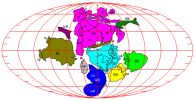 Neoproterozoic Era (1000 to 542 mya) Tonian Period (1000 to 850 mya) - 1000 mya: Multicellular organisms appear. - 950 mya: Start of Stuartian-Varangian ice age - 900 mya: Earth day is 18 hours long. The Moon is 350,000 km from Earth.[31] Cryogenian Period (850 to 630 mya) 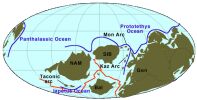 - 750 mya: Breakup of Rodinia - 650 mya: *  Mass extinction of 70% of dominant sea plants Mass extinction of 70% of dominant sea plantsdue to global glaciation ("Snowball Earth" hypothesis). The Moon is 357,000 km from Earth.[31] Ediacaran (Vendian) Period (630 to 542 mya) - 600 mya: Formation of the supercontinent Pannotia Earth day is 20.7 hours long.[35] - 590 mya: Meteor impact, 90 km craterAcraman, South Australia  - 580 mya: Soft-bodied organisms developed: Jellyfish, Tribrachidium, and Dickinsonia 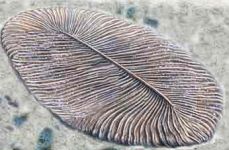 appeared. appeared.- 570 mya: End of Stuartian-Varangian ice age Shelled invertebrates appeared - 550 mya: Pannotia fragmented into Laurasia and Gondwana  |
|
|
Phanerozoic Eon (542 mya to present) |
||
| Paleozoic Era (542 to 251 mya) | ||

|
Cambrian Period (542 to 488.3 mya) - Abundance of multicellular life. - Most of the major groups of animals first appear Tommotian Stage (534 to 530 mya) - 510 mya: Vertebrates appeared in the ocean. Solar brightness was 6% less than today. Ordovician Period (488.3 to 443.7 mya) 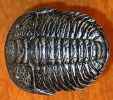 - diverse marine invertebrates, such as trilobites, became common - First green plants and fungi on land. - Fall in atmospheric carbon dioxide. - 450 mya: Start of Andean-Saharan ice age. - 443 mya: Glaciation of Gondwana. * Mass extinction of many marine invertebrates.Second largest mass extinction event. 49% of genera of fauna disappeared. Silurian Period (443.7 to 416 mya)  - 420 mya: End of Andean-Saharan ice age. - Stabilization of the earth's climate - Land plants and coral reefs appeared - First fish with jaws - sharks - Insects (spiders, centipedes), and plants appear on land Devonian Period (416 to 359.2 mya)  - Ferns and seed-bearing plants (gymnosperms) appeared - Formation of the first forests - Earth day is ~21.8 hours long. - 400 mya: Land animals appeared, wingless insects - 376 mya:  Viluy Traps Large Igneous Province volcanic eruption Viluy Traps Large Igneous Province volcanic eruption- 375 mya: Vertebrates with legs, such as Tiktaalik  appeared. appeared.- Atmospheric oxygen level is about 16%  - First amphibians appear. - 374 mya: * Mass extinction of 70% of marine species.This was a prolonged series of extinctions occurring over 20 million years. Evidence of anoxia in oceanic bottom waters, and global cooling. Surface temperatures dropped from about 93°F (34°C) to about 78°F (26°C) - 370 mya: First trees appeared - 359 mya: Meteor impact, 40 km craterWoodleigh, Australia Carboniferous Period (359.2 to 299 mya) Mississippian Epoch (359.2 to 318.1 mya) (Lower Carboniferous) - 350 mya: Beginning of Karoo ice age. 

- Large primitive trees develop - First winged insects - Forests consist of ferns, club mosses, horsetails, and gymnosperms. - Oxygen levels increase - 324 mya: Synapsid vertebrates, the ancestors of mammals, appear on land. - Seas covered parts of the continents - Animals laying amniote eggs appear (318 mya) Pennsylvanian Epoch (318.1 to 299 mya) (Upper Carboniferous) - 300 mya: First reptiles (diapsids) appeared. They were ancestors of crocodiles, dinosaurs and pterosaurs. - Atmospheric oxygen levels reach over 30% - Earth day is ~22.4 hours long. The Moon is 375,000 km from Earth.[31] 

- Giant arthropods populate the land - Transgression and regression of the seas caused by glaciation - Deposits of coal form in Europe, Asia, and North America Permian Period (299 to 251 mya)  - 275 mya: Formation of the supercontinent Pangea 
 - Conifers and cycads first appear - Earth is cold and dry  - Sail-backed synapsids like Edaphosaurus and Dimetrodon appeared - 260 mya: End of Karoo ice age. - 252 mya: Period of great volcanism in SiberiaSiberian Traps Large Igneous Province releases large volume of gases (CO2, CH4, and H2S) [8] - Oxygen (O2) levels dropped from 30% to 12% Carbon dioxide (CO2) level was about 2000 ppm Temperatures reach 50-60°C on land, and 40°C at the sea-surface.[37] - 251 mya: * Mass extinction (Permian-Triassic)- Possible 480km-wide meteor crater in the Wilkes Land region of Antarctica [26] Earth's worst mass extinction eliminated 90% of ocean dwellers, and 70% of land plants and animals. 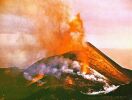

|
|
| Mesozoic Era (251 to 65.5 mya) | ||

|
Triassic Period (251 to 199.6 mya) - Break-up of Pangaea starts - Survivors of P-T extinction spread and recolonize 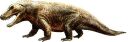 - Reptiles populate the land. - 240 mya: Sea urchins (Arkarua) appear - 235 mya: Evolutionary split between dinosaurs and lizards - Giant marine ichthyosaurs and plesiosaurs populate the seas - First small dinosaurs such as coelophysis appear on land - Adelobasileus proto-mammal emerged (225 mya) 
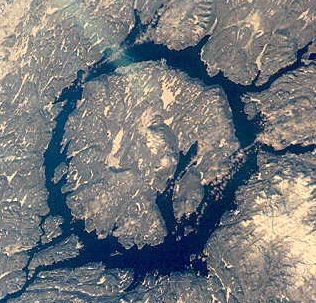
- 214 mya: Meteor impact, 100 km craterManicouagan, Quebec, Canada [9] - 205 mya: First evidence of mammals: Morganucodon - 201 mya: Central Atlantic Large Igneous Province volcanic eruption[38]* Mass extinction killed 20% of all marine familiesJurassic Period (199.6 to 145.5 mya) - Earth is warm. There is no polar ice - Cycads, conifers and ginkgoes are the dominant plants - Age of the dinosaurs - Giant herbivores and vicious carnivores dominate the land - Flying reptiles (Pterosaurs) appeared. 


- 180 mya: North America separates from Africa  - 167 mya: Meteor impact, 80 km craterPuchezh-Katunki, Russia [9] - 166 mya: Evolutionary split of monotremes from primitive mammals  - 150 mya: First birds like Archaeopteryx appear - 148 mya: Evolutionary split between marsupial and eutherian mammals - 145 mya: Meteor impact, 70 km craterMorokweng, South Africa [9] Cretaceous Period (145.5 to 65.5 mya) - Period of Active Crust Plate Movements - 133 mya: Meteor impact, 55 km craterTookoonooka, Australia [9] - 125 mya: Africa and India separate from Antarctica  - Flowering plants (angiosperms) appeared Montsechia vidalli was one of the first angiosperms. - 120 mya: Global warming event starts Carbon dioxide levels were 550 to 590 ppm [27] - Proliferation of single-cell organisms (diatoms, dinoflagellates, and calcareous nannoplankton) changed ocean composition. - 116 mya: First birds with beaks without teeth. - 110 mya: Crocodiles appeared - Snakes evolved during the mid-Cretaceous - 105 mya: South America breaks away from Africa - Formation of the Atlantic Ocean  - Earth has no polar ice - Oldest group of living placental mammals developed - 100 mya: Earth's magnetic field is 3 times stronger than today.  First ants (hymenoptera) appeared - 90 mya: Global warming event ends - Western Interior Seaway separates North America into Laramidia (west) and Appalachia (east) - 85 mya: Australia starts to separate from Antarctica Dinilysia Patagonica - first snake without legs [44] - 70 mya: Meteor impact, 65 km craterKara, Russia [9]  Caution: Do not poke T. rex
- 68 mya: Tyrannosaurus rex thrived - 67.5 mya: Deccan Traps Large Igneous Province volcanic eruptionsstart in India and produce great volume of lava and gases.  - 65.5 mya: Meteor impact, 170 km craterChicxulub, Yucatan, Mexico [9] - * Mass extinction of 80-90% of marine speciesand 85% of land species, including the dinosaurs. |
|
| Cenozoic Era (65.5 mya to today) | ||

|
Paleogene Period (65.5 to 23.03 mya)
Tertiary Period (65.5 to 2.58 mya)  Paleocene Epoch (65.5 to 55.8 mya) - 63 mya: End of Deccan Traps volcanic eruptions in India - Flowering plants become widespread. - 70% of new bird lineages evolved within five million years after the extinction of the dinosaurs. - Social insects achieve ecological dominance.  - Appearance of placental mammals (marsupials, insectivores, lemuroids, creodonts) - 60 mya: Earliest known ungulate (hoofed mammal) - The Laramide orogeny starts forming the Rocky Mountains and draining the Western Interior Seaway. - First appearance of grasses.[43] - 55.8 mya: Major global warming episode (PETM)[39] North Pole temperature averaged 23°C (73.4°F), CO2 concentration was 2000 ppm. Eocene Epoch (55.8 to 33.9 mya) - 50 mya: India meets Asia forming the Himalayas - 45 mya: Earth day is 24 hours long. The Moon is 378,000 km from Earth.[32] - Modern mammals appear rhinoceros, camels, early horses and lemur-like primates appear - 35.6 mya: Meteor impacts, 90 and 100 km cratersChesapeake Bay, Virginia, USA, and Popigai, Russia [9,10] - Global temperature dropped 10°C during the Eocene. - 34 mya: Global cooling creates permanent Antarctic ice sheet [21] Oligocene Epoch (33.9 to 23.03 mya) - 30 mya: Australia and South America separate from Antarctica  - First elephants with trunks - 27.8 mya: La Garita, Colorado supervolcanic eruption
Neogene Period (23.03 mya to today)
Miocene Epoch (23.03 to 5.3 mya) - African-Arabian plate joined to Asia - 21 to 14 mya: Miocene warming period - 14 mya: Circum-polar ocean circulation builds up Antarctic ice cap. - 14 to 6 mya: Global temperature drops by 4°C. - First raccoons appear. - Drying of continental interiors - Forests give way to grasslands - 6 mya: Upright walking (bipedal) hominins appear Pliocene Epoch (5.3 to 2.58 mya) - 4.4 mya: Appearance of Ardipithecus, an early hominin genus. - 4 mya: North and South America join at the Isthmus of Panama. Animals and plants cross the new land bridge. Ocean currents change in the newly isolated Atlantic Ocean. 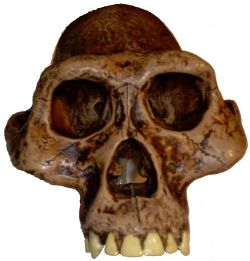

- 3.9 mya: Appearance of Australopithecus, genus of hominids. - 3.7 mya: Australopithecus hominids inhabit Eastern and Northern Africa. - 3 mya: Formation of Arctic ice cap. - Accumulation of ice at the poles - Climate became cooler and drier. - Spread of grasslands and savannas - Rise of long-legged grazing animals Quaternary Period (2.58 mya to today) Pleistocene Epoch (2.58 mya to 11,400 yrs ago) - Several major episodes of global cooling, or glaciations 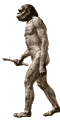

- 2.4 mya: Homo habilis appeared - 2.1 mya: Yellowstone supervolcanic eruption - 2 mya: Tool-making humanoids emerge. Beginning of the Stone Age. - 1.7 mya: Homo erectus first moves out of Africa - 1.3 mya: Yellowstone supervolcanic eruption - 1.3 mya to 820,000 yrs ago: Sherwin Glaciation - Presence of large land mammals and birds - 790,000 yrs ago: First use of fire by hominds[40] - 700,000 yrs ago: Human and Neanderthal lineages start to diverge genetically. - 680,000 to 620,000 yrs ago: Günz/Nebraskan glacial period - 640,000 yrs ago: Yellowstone supervolcanic eruption - 530,000 yrs ago: Development of speech in Homo Heidelbergensis[15] - 455,000 to 300,000 yrs ago: Mindel/Kansan glacial period - 400,000 yrs ago: Hominids hunt with wooden spears and use stone cutting tools. - 370,000 yrs ago: Human ancestors and Neanderthals are fully separate populations.  - 300,000 yrs ago: Hominids routinely use controlled fires - 230,000 yrs ago: Neanderthal man spreads through Europe - 200,000 to 130,000 yrs ago: Riss/Illinoian glacial period - 160,000 yrs ago: Homo sapiens appeared. Origin of human female lineage.[3] - 125,000 yrs ago: Eemian stage or Riss/Würm interglacial period. Hardwood forests grew above the Arctic Circle. Melting ice sheets increased sea level by 6 meters (20 feet) - 110,000 yrs ago: Start of Würm/Wisconsin glacial period - 105,000 yrs ago: Stone age humans forage for grass seeds such as sorghum. - 80,000 yrs ago: Non-African humans interbreed with Neanderthals[28] - 74,000 yrs ago: Toba volcanic eruption releases large volume of sulfur dioxide - 71,000 yrs ago: Invention of the bow and arrow.[41] - 70,000 yrs ago: Tahoe glacial maximum glaciers cover Canada and northern US. - 55,000 yrs ago: Humans colonize Australia - 46,000 yrs ago: Australia becomes arid, bush fires destroy habitat, and megafauna die off.  - 40,000 yrs ago: Cro-Magnon man appeared in Europe. - 28,000 yrs ago: Neanderthals disappear from fossil record.[29] - 26,500 yrs ago: Taupo supervolcanic eruption in New Zealand. - 22,000 yrs ago: Tioga glacial maximum sea level was 130 meters lower than today. - 20,000 yrs ago: Invention of fired ceramic pottery. - 19,000 yrs ago: Antarctic sea ice starts melting.[22] - 15,000 yrs ago: Human migration from Asia to America.  - 12,900 yrs ago: Comet impact by Great Lakes [23, 24, 25]Extinction of American megafauna such as the mammothand sabretooth cat (Smilodon), as well as the end of Clovis culture - 12,000 yrs ago: Construction of Göbekli Tepe in Turkey. - 11,400 yrs ago: End of Würm/Wisconsin glacial period. Sea level rises by 91 meters (300 ft) Holocene Epoch (11,400 years ago to today) - Development of agriculture - Domestication of animals. - 9,000 yrs ago: Metal smelting started - 5,500 yrs ago: Invention of the wheel - 5,300 yrs ago: The Bronze Age - 5,000 yrs ago: Development of writing  - 4,500 yrs ago: Pyramids of Giza - 3,300 yrs ago: The Iron Age - 2,240 yrs ago: Archimedes develops formula for the volume of a sphere. - yrs ago: Start of the Common Era (CE) - 1781 CE: James Watt patented a steam engine that powered the Industrial Revolution. - 1880 CE: Beginning of commercial use of electricity. - 1945 CE: Atomic age - First nuclear explosion - 1957 CE: Space age - Launch of Sputnik Man-made satellite orbits the Earth.  - 1969 CE: Humans walk on the surface of the Moon. - 1969 CE: Start of the Internet global information network. |
|
Extinction Events
There have been five major mass extinctions events: the terminal Ordovician (443 mya),
Late Devonian (374 mya), terminal Permian called the "Great Dying" (251 mya), terminal Triassic (201),
and terminal Cretaceous called the K/T event (65.5 mya). The Ordovician extinction was
caused by global cooling and glaciation. The other four are associated
with prolonged volcanism in large igneous provinces, although a meteorite impact also contributed
to the K/T event.
Humans as agents of environmental change
Some scientists have tried to correlate the migration of humans to America with the extinction of
the megafauna of the Pleistocene Epoch while others feel that weather changes brought about by
the explosion of an asteroid or comet over North America might have been responsible.[25]
There is no doubt that human activities can have a substantial impact on the environment and
native species. The dodo, a flightless bird indigenous to Mauritius, became extinct in the late 17th century
from massive hunting and the introduction of animals such as dogs, pigs, and cats.
The Passenger Pigeon went from being the most common bird in North America to extinction by the
end of the 19th century due to hunting and loss of habitat by deforestation.
Overfishing the costal waters of California in 1945 produced 235,000 tons of fish, but
in 1948 only 15,000 tons of fish were caught which led to the collapse of Cannery Row.
The Dust Bowl was a man-made ecological disaster caused by deep plowing of the
top soil of the Great Plains which destroyed native grasses whose roots had protected the soil
from erosion. Drought and wind created a period of severe dust storms between 1930 and 1936.
Soils that had been fertile became incapable of growing crops after
the top soil was blown away. The contemporary destruction of tropical forests
by the logging industry and the large-scale clearing of forests to plant commercial crops
is already having harmful ecological effects that are likely to
become worse if non-sustainable practices continue to be used.
The Earth's near-term future
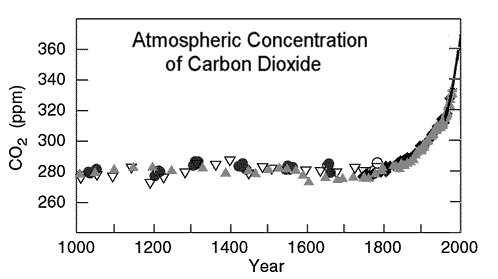
Human industrial activity that relies on burning fossil fuels, such as coal and petroleum products,
has been generating the greenhouse gases carbon dioxide (CO2),
methane (CH4), and nitrous oxide (N2O), in large quantities since about 1750.
The chart below shows the levels of atmospheric carbon dioxide during the last millennium and its
sharp rise during the last century.[2]
Atmospheric models predict that elevated greenhouse gases will cause global warming and influence weather patterns
that will melt polar ice and destroy the habitat of animals such as the polar bear.
The increase of global temperatures will also reduce the amount of snow deposited on mountains thus
decreasing the flow of water in rivers which are now used for navigation, irrigation, and as sources of potable water.
Carbon dioxide will also increase the acidity of sea water and threaten
coral reefs and shell-building oceanic life forms.
As of February 2016, the monthly average level of carbon dioxide was 404.02 ppm at the National Oceanic & Atmospheric Administration (NOAA) laboratory in Mauna Loa, Hawaii, and the level continues to increase steadily. In the following image, the dashed red line represents the monthly mean values of CO2 with the points centered on the middle of each month. The black line represents the same, after correction for the average seasonal cycle.

Analysis of core sediments in the Arctic Circle indicate that 55 million years ago, the carbon dioxide concentration was 2,000 ppm and the North Pole's temperature averaged 23°C (73.4°F) compared to a mean annual temperature of -20°C today.[4] Satellite images by NASA show approximately a 20% reduction in the Earth's minimum ice cover between 1979 and 2003.[5] Arctic perennial sea ice has been decreasing at a rate of 9% every ten years. At this rate, the summertime Arctic Ocean will be ice-free before the year 2100.

There is a large amount of water stored as ice over the landmasses of Greenland and Antarctica. If the ice sheets melt, the resulting rise in global sea level will flood many coastal areas around the world. The Greenland ice sheet contains enough water to increase the global sea level by 24 feet (7.3 meters), the West Antarctic ice sheet could raise sea level by 19 feet (5.8 meters), and the East Antarctic ice sheet could raise the sea level globally by 170 feet (51.8 meters).[12] The combined effect of melting all the ice on Greenland and Antarctica would result in a sea level rise of 213 feet (65 meters).
Using computer models, scientists at the University of Arizona Department of Geosciences have created maps that show areas susceptible to rises in sea level (in red). The following map shows that a 6-meter (20-foot) rise would flood Miami, Fort Lauderdale, Tampa, and the entire Florida coastline, as well as parts of Orlando and other inland areas. Most of the city of New Orleans, Louisiana will disappear under water if the sea rises six meters. Some scientists have warned that by the year 2200, at the current rate of greenhouse gas emissions from human activities, the atmospheric levels of carbon dioxide, methane, and nitrous oxide will be at the same levels associated with mass-extinction events in the Earth's past.[8]
;w1.focus())

;w1.focus())
The Earth's long-term future
The future of the Earth is linked to the fate of the Sun. The Sun is halfway through its life cycle and will exhaust
its supply of hydrogen fuel in around 4,000 million years. As the Sun cools, its core will collapse and its
atmosphere will expand transforming the Sun into a red giant star.
The swelling Sun will engulf the planets closest to it, and the Earth will be completely vaporized.
The Sun will die in several stages. When its core crashes inwards, it will start fusing helium atoms into carbon.
When the helium supply runs out, the center will collapse again and
form a white dwarf star that will become dimmer until its light finally fades.
The final collapse of stars which are a few times larger than the Sun ends in a massive supernova explosion that
leaves behind a rapidly spinning neutron star.
Long before the Sun becomes a white dwarf, 2,000 million years from now, our Milky Way Galaxy is predicted to collide with the Andromeda Galaxy.[13] The collision will take place for several million years and result in one combined super galaxy named Milkomeda. The sun may become part of the Andromeda system during the collision and could eventually end up far away from the new merged galactic center. The Earth may also eventually lose its Moon. Scientists using the laser ranging retroreflector positioned on the Moon in 1969 by the Apollo 11 astronauts have determined that the Moon is receding from Earth at a rate of about 3.8 centimeters per year.
| Earth's Long-Term Future | |
|---|---|
|
+200 years: Possible global warming event caused by anthropogenic carbon dioxide (CO2)[8] +1500 my: Sun is about 6000 million years old and 15% brighter than today. +2000 my: Milky Way Galaxy starts colliding with Andromeda Galaxy.[13] +3000 my: Solar system becomes part of the new Milkomeda Galaxy. +4000 my: Sun is about twice as bright as today and its radius is 40% greater. Sun starts to exhaust its supply of hydrogen. +5000 my: Sun starts changing into a red giant star, 3 times its present size.[18] Earth is engulfed by the red giant Sun. +10000 my: Red giant Sun collapses and becomes a white dwarf. +20000 my: White dwarf Sun becomes a black dwarf. |
|
Glossary
Aeon - See Eon.
Age - An age is a unit of geological time shorter than an epoch,
usually lasting several million years.
Anthropocene - A proposed era denoting the time when human activity started
having a global impact on the Earth's surface, atmosphere and hydrosphere.
Archean, Archaean - An eon of geologic time extending from about 4000 to 2500 million years ago.
Derived from the Greek archaios meaning "ancient". The Archean eon is divided into
four eras: Eoarchean, Paleoarchean, Mesoarchean, and Neoarchean.
Cambrian - The first period of the Paleozoic Era, during which most modern animal phyla developed.
The name derives from Medieval Latin Cambria "Wales".
Cenozoic, Caenozoic, Cainozoic - The current geologic era, which began 65.5 million years ago and continues to the present.
The word comes from the Greek kainos "new" + zoe "life".
Cretaceous - A Period from 145 to 65.5 million years ago divided into two epochs:
The Early Cretaceous Epoch had six Ages:
Cenomanian, Turonian, Coniacian, Santonian, Campanian, and Maastrichtian.
The Late Cretaceous Epoch had six Ages:
Berriasian, Valanginian, Hauterivian, Barremian, Aptian, and Albian.
Eocene Epoch - An epoch from 54.8 to 33.9 million years ago with four Ages:
Ypresian, Lutetian, Bartonian, and Priabonian.
Eon - A primary division of geologic time lasting over 500 million years,
four of which have been defined: Hadean, Archean, Proterozoic,
and Phanerozoic. Eons are divided into Eras, which are in turn divided into Periods, Epochs and Ages.
Epoch - A division of geologic time lasting tens of millions of years. Epochs are subdivisions of
geologic periods.
Era - A division of geologic time of several hundred million years in duration.
An era is smaller than an eon and longer than a period.
Geologic Time Scale - A categorization of geological events based on successively smaller time spans:
eons, eras, periods, epochs, and ages.
Hadean - The earliest eon in the history of the Earth from the first accretion of planetary material
until the date of the oldest known rocks. The name "Hadean" derives from the Greek Hades "Hell".
Holocene - An epoch starting 11,400 years ago to today. From holo- "whole" + Greek kainos "new".
Jurassic - A Period from 200 to 145 million years ago divided into three epochs:
The Early Jurassic Epoch has four Ages: Hettangian, Sinemurian, Pliensbachian, and Toarcian.
The Middle Jurassic Epoch has four Ages: Aalenian, Bajocian, Bathonian, and Callovian.
The Late Jurassic Epoch has three Ages: Oxfordian, Kimmeridgian, and Tithonian.
Mesoproterozoic - an era with three periods: Calymmian, Ectasian, and Stenian.
Mesozoic - An era of time during the Phanerozoic eon lasting from 251 million years ago to
65.5 million ago. Derived from the Greek mesos "middle" + zoe "life".
Miocene Epoch - An epoch from 23.03 to 5.3 million years ago with six Ages:
Aquitanian, Burgidalian, Langhian, Serravalian, Tortonian, and Messinaian.
The name is derived from Greek meiōn "less" + kainos "new".
Neogene - A period from 23.03 to today. This is the new name given to the time starting from
the Miocene Epoch to today.
Neoproterozoic - An era with three periods: Tonian, Cryogenian, and Ediacaran.
Oligocene Epoch - An epoch from 33.9 to 23.03 million years ago with two Ages:
Rupelian and Chattian. Derived from oligo- "few" + Greek kainos "new".
Paleocene, Palaeocene Epoch - An epoch from 65.5 to 54.8 million years ago with three Ages:
Danian, Selandian, and Thanetian.
Paleogene - A period from 65.5 to 23.03 million years ago. This is the new name given to
the first portion of the Tertiary Period.
Paleoproterozoic - an era with four periods: Siderian, Rhyacian, Orosirian, and Statherian.
Paleozoic, Palaeozoic - An era of geologic time lasting from 542 to 248 million years ago.
Derived from the Greek palai "long ago, far back" + zoe "life".
Period - A division of geologic time lasting tens of millions of years which shorter than an era and longer than an epoch.
Phanerozoic - The most recent eon of geologic time beginning 542 million years ago and continuing to
the present. Derived from the Greek phaneros "visible" + zoe "life".
Pleistocene - An epoch from 2.58 mya to 11,400 years ago. Derived from Greek pleistos "most" + kainos "new".
Pliocene - An epoch from 5.3 to 2.58 million years ago with two Ages:
Zanclean and Piacenzian. Derived from Greek pleiōn "more" + kainos "new".
Precambrian - Geologic time from the beginning of the earth to the beginning of the Cambrian Period of
the Paleozoic Era.
Proterozoic - The geologic eon lying between the Archean and Phanerozoic eons, beginning
about 2500 and ending 542 million years ago. Derived from the Greek
proteros "earlier" + zoe "life". The Proterozoic eon is divided into the
Paleoproterozoic era, Mesoproterozoic era, and Neoproterozoic era.
Quaternary - An informal sub-era from 2.58 or 1.8 mya to today. The Quaternary is traditionally associated with the Holocene and
Pleistocene, but an alternative definition sets its start during the cycle of glacials and interglacials around 2.6 mya.
Stage - A succession of rock strata laid down in a single age on the geologic timescale.
Tertiary - An informal sub-era from 65.5 to 2.58 or 1.8 million years ago, depending on how the Quaternary is defined.
The Tertiary overlaps with the Neogene Period and is divided into five epochs:
Paleocene, Eocene, Oligocene, Miocene, and Pliocene.
Triassic - A Period from 251 to 200 million years ago divided into three epochs:
The Early Triassic Epoch has two Ages: Induan and Olenekian.
The Middle Triassic Epoch has two Ages: Anisian and Ladinian.
The Late Triassic Epoch has three Ages: Carnian, Norian, and Rhaetian.
Frequent misspellings of geologic terms and Evolutionary periods of the Earth:
creataceous, cretaceus, cretacous, jurassique, jurasik, jurasic, jurossic, myscene, myocene, myoscene,
phanaerozoic, triasic