 Index
Index

Dietary Fat
The recommendation from the National Cholesterol Education Program states that a
cholesterol-reducing diet should contain less than 7% of calories from saturated fat
and less than 200 mg of dietary cholesterol per day. What exactly does this mean?
For a 2000-calorie diet, 7% corresponds to about 15 grams (about one tablespoon) of saturated fat, but
to make sense of this information, you need to know the difference between "saturated",
"monounsaturated", and "polyunsaturated" fatty acids.
This is explained in the section on fats.

Saturated Fats are not only Animal Fats
Many people equate saturated fats with animal fats, but this is not correct.
The fatty acid composition of lard (pork fat) is very similar to human depot fat around
the waist and hips.
Lard consists of approximately 42% saturated and 58% unsaturated fatty acids.
Coconut oil, by contrast,
consists of 83% saturated fatty acids. So, lard is better than coconut oil as far as
saturation is concerned. However, lard contains 12 mg of cholesterol per tablespoon
because it is an animal product, whereas coconut oil has no cholesterol because it is a plant product.
Nevertheless, coconut oil will increase cholesterol twice as much as lard because it has double the
amount of saturated fat.
The comparison of the fatty acid profiles of many edible fats can be found in the
chemical description of triglycerides.
Saturated fats, whether from vegetable or animal sources, increase cholesterol.
Avoid Hydrogenated Fats
Hydrogenated fats and partially hydrogenated fats affect the body like saturated fats.
Partially hydrogenated fats, in particular, contain dietary trans fats that raise the level of
low-density lipoproteins (LDL or "bad cholesterol")
increasing the risk of coronary heart disease. Trans fats also
reduce high-density lipoproteins (HDL or "good cholesterol"), and raise
levels of triglycerides in the blood. Both of these conditions are associated with insulin resistance
which is linked to diabetes, hypertension, and cardiovascular disease.
Harvard University researchers have reported that people who ate partially
hydrogenated oils, which are high in Trans fats,
had nearly twice the risk of heart attacks compared with those
who did not consume hydrogenated oils. Avoid any products with hydrogenated and
partially hydrogenated fats.
Learn to read labels carefully.
Some of your favorite foods may have hydrogenated fats that
increase your cholesterol.


Balancing Fatty Acids
The recommendation by government agencies and by the American Heart Association
to reduce saturated fat and to increase polyunsaturated fat is based on
research that describes how blood cholesterol is affected by fats.
In 1965, Hegsted published the results of experiments on the quantitative effects of
fatty acids on blood serum cholesterol.[4] The experiments showed that of all the fatty acids
in food, only three affected the cholesterol level significantly. Myristic acid (C14:0)
increased cholesterol strongly, and palmitic acid (C16:0) also increased cholesterol.
Some saturated fatty acids, such as stearic acid (C18:0), had relatively little
effect on blood cholesterol. Polyunsaturated fatty acids, such as linoleic acid (C18:2), decreased cholesterol.
Dietary cholesterol also increased blood cholesterol.
The response of the human body to dietary fats is so consistent that Hegsted was able to
derive the following mathematical equation:
Where ΔTC is the change in serum cholesterol in mg/dL. ΔC14:0, ΔC16:0, and ΔPoly are the changes in %kcal.
ΔDietaryCholesterol is in mg/1000 kcal.
Mensink and Katan developed a similar equation based on a detailed analysis of published research[6]:
Where the ΔTC is the change in serum cholesterol values in mg/dL, ΔS is change in percentage of energy from lauric, myristic, and palmitic fatty acids, ΔM is change in energy from monounsaturated fatty acids, and ΔP is change in energy from polyunsaturated fatty acids.
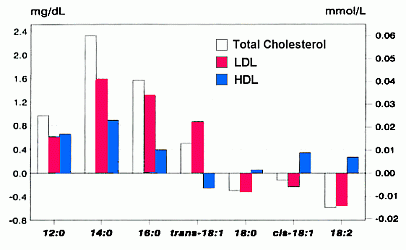
The chart above shows the effects of individual dietary fatty acids on Total Serum Cholesterol, LDL cholesterol, and HDL cholesterol when 1% of the energy from carbohydrates in the diet is replaced by 1% of energy of the specific fatty acids. The chart shows cholesterol increases from lauric acid (C12:0), myristic acid (C14:0), and palmitic acid (C16:0) which are found in coconut oil, palm oil, and butter. Elaidic acid (trans-C18:1), which is present in hydrogenated fats, is the worst because it increases LDL and decreases HDL. The saturated fatty acid stearic acid (C18:0), the monounsaturated oleic acid (C18:1), and the polyunsaturated linoleic acid (C18:2) decrease LDL and increase HDL to various degrees.[14]
These equations and the chart tell us that blood cholesterol can be lowered by avoiding hydrogenated fats, decreasing carbohydrates, and increasing the consumption of polyunsaturated fatty acids such as linoleic acid (C18:2) and alpha-linolenic acid (C18:3) while reducing our consumption of saturated fatty acids like myristic (C14:0) and palmitic (C16:0) acids. Furthermore, the equations make it possible to calculate the effect of various diets or oils on blood cholesterol levels. For example, one tablespoon of butter raises cholesterol as much as 3 tablespoons of lard. Whereas one tablespoon of grape seed oil lowers cholesterol to the same extent that 2 tablespoons of lard increases it. Olive oil does not lower cholesterol significantly because it consists mainly of monounsaturated fat. Polyunsaturated fats are more effective at lowering cholesterol. (See details for various fats). A good diet strategy would be to trim the fat from meats, and accompany the entrees with salads containing salad dressing made with grape seed oil. Safflower oil and sunflower oil can be substituted for the grape seed oil, but only if they are not the "high oleic" variety. Make sure that the quantity of polyunsaturated fat in the label is at least 3 times greater than the monounsaturated fat, as illustrated here:


Carbohydrate Metabolism
Carbohydrates are normally metabolized for energy or stored as glycogen in the muscles, but
excess carbohydrates are converted to fat, mainly the saturated palmitic acid (C16:0).
The metabolic process is known as de novo synthesis of fatty acids and it involves the
conversion of glucose to pyruvate, and then to fatty acids through acetyl coenzyme-A (acetyl CoA).

Omega-3 and Omega-6 fatty acids
People on low-fat diets or with plenty of "healthy" monounsaturated fats from olive oil and avocados
are sometimes surprised that their cholesterol level is high
even though they consume enough fiber and limit their sources of saturated fats and dietary cholesterol.
In these cases, cholesterol levels are elevated because the diet does not have polyunsaturated
fats to balance the cholesterolemic effect of the palmitic acid created from carbohydrates.
Adding sources of polyunsaturated fats to the diet like sunflower seeds, walnuts, or
grape seed oil and reducing excessive use of saturated and monounsaturated fats provides the
fatty acid balance necessary to normalize cholesterol.
Linoleic acid (C18:2), an omega-6 essential fatty acid, and alpha-linolenic acid (C18:3), an
omega-3 essential fatty acid, must be included in the diet
because the human metabolism cannot create them from other fatty acids.
Mensink and Katan developed equations that calculate the changes in serum lipid and lipoprotein levels caused by isocaloric exchanges of carbohydrates and fatty acids.[6]
The changes (Δ) are in milligrams per deciliter. Expressions in parentheses denote the percentage of daily energy intake from carbohydrates that is replaced by saturated (sat), cis-monounsaturated (mono), or polyunsaturated (poly) fatty acids.
These equations tell us that triglycerides (TG) can be reduced, and HDL can be increased, by reducing carbohydrates in the diet while increasing fats by an equal number of Calories. However, LDL can only be lowered by decreasing the amount of saturated fat relative to the mono- and polyunsaturated fat. The most favorable lipoprotein risk profile for coronary heart disease can be achieved if saturated fatty acids are replaced by unsaturated fatty acids, with no decrease in total fat intake.
Alcohol consumption raises HDL
The observation that moderate alcohol intake is associated with lower atherosclerosis risk gave rise to the term "French Paradox",
which refers to the fact that the French suffer a lower incidence of coronary heart disease than Americans,
despite consuming relatively more saturated fats. Research suggests that moderate drinkers are less likely
to suffer heart attacks than abstainers or heavy drinkers. Alcohol consumption raises
HDL cholesterol levels by increasing the transport rate of apolipoproteins A-I and A-II.[13]
The equivalent of one shot glass of vodka per day increased HDL cholesterol concentration by 18%
compared with the control, and the amount of alcohol consumed correlated with the degree of increase in HDL.


Choosing your foods to reduce LDL
Although your overall cholesterol can be lowered by adding polyunsaturated fats to your diet and decreasing
carbohydrates, it is possible for your Total Cholesterol to be normal while your LDL is elevated.
Examination of the equation for the change in LDL shows how this can be remedied:
Basically, LDL increases by a factor of 1.28 for every increase in saturated fat, while it decreases by factors of 0.24 and 0.55 for equal increases in monounsaturated fat and polyunsaturated fat, respectively. This means that LDL can be lowered by reducing the dietary saturated fats and replacing them with polyunsaturated and monounsaturated fats. The following table shows the content of saturated fat in various meat and dairy products. The beef and chicken are assumed to be broiled. Fish and skinless chicken breast are your best choices. The fish with the highest levels of omega-3 fatty acids are: mackerel, lake trout, herring, sardines, albacore tuna and salmon.
| Food | Calories |
Saturated Fat (grams) |
|
|---|---|---|---|
| Beef | T-bone trimmed to 1/8" fat | 486 | 13.3 |
| T-bone trimmed to 0" fat | 336 | 5.6 | |
| Top Sirloin trimmed to 0" fat | 319 | 4.2 | |
| Chicken | Thigh (skinless) | 355 | 5.2 |
| Leg (skinless) | 324 | 3.9 | |
| Breast (skinless) | 280 | 1.7 | |
| Fish | White tuna packed in water | 217 | 1.3 |
| Dairy | 1 pat of butter | 36 | 2.6 |
| 1 cup whole milk | 146 | 4.6 | |
Effect of Fiber
Bile is a digestive liquid produced by the liver consisting of
bile acids, cholesterol, phospholipids, and bilirubin.
Bile is stored in the gallbladder and then released into the small intestine (the duodenum)
to emulsify fats. The primary bile acids are chenodeoxycholic acid (45%) and cholic acid (31%).
These bile acids are converted by intestinal bacteria to the secondary bile acids
deoxycholate and lithocholate.
Both primary and secondary bile acids are reabsorbed by the intestines and delivered back
to the liver through the blood stream.

Fiber in the diet can lower blood cholesterol by binding with the components of the bile
and preventing their reabsorption.
Only soluble fiber has been shown to help lower blood cholesterol when regularly eaten
as part of a diet low in saturated fat and cholesterol. Foods high in soluble fiber include oat bran,
oatmeal, beans, peas, rice bran, barley, mangos, citrus fruits (including the pulp, not just the juice),
strawberries and apple pulp.
Dietary supplements with psyllium (Metamucil


Insoluble fiber does not lower blood cholesterol, but it is important for normal bowel function. Foods high in insoluble fiber include whole-wheat breads, wheat cereals, wheat bran, beets, cabbage, carrots, Brussels sprouts, turnips, cauliflower and apple skin.
Dietary Cholesterol
One question that always comes up is: "Can I eat eggs?" Sources of dietary cholesterol do increase
blood serum cholesterol, so they should be limited to reduce cholesterol. However, egg whites are a
good source of protein and have no cholesterol. Only the yolks have cholesterol.
The body responds to dietary cholesterol in approximately linear fashion. Each 1 mg/1000 kcal results in
an increase of serum cholesterol of about 0.1 mg/dl.
This means that eating one whole egg per day, which has approximately 210 mg of
cholesterol, would increase serum cholesterol by approximately 8 mg/dl for someone
eating 2500 Calories per day.
The following is a comment about this topic from Dr. J. L. De Foa (Aug 18, 2017).
I've enjoyed reading through your pages on cholesterol and the equations that predict changes in cholesterol and its distribution in lipoproteins.
You are likely well aware the industry funded "saturated fat is bad" while "oils pressed in factories from (GMO) seeds is good" diet advice of the past 40 years is being challenged. Lowering Total Cholesterol can be harmful, especially in older folks, many of those having heart attacks have "at target or below" LDL-C (even without using statins) and not all LDL particles are bad.
Perhaps the most important thing to emphasize is that LOWERING CARBOHYDRATES and REPLACING THEM WITH FATS will improve cholesterol indices.
Perhaps you have heard of the use of the TG/HDL-C ratio as a predictor of prevalence of small dense DANGEROUS LDL particles, rather than LARGE FLUFFY harmless LDL particles. It has long been known that higher HDL-C suggests lower cardiac disease risk. It seems that high TG is associated with higher TG risk, so lower TG is better.
From your equations I see that one would raise HDL most effectively by replacing carbohydrates (especially the starch and sugary kinds that raise insulin the most) with Saturated Fat > Monounsaturated > Polyunsaturated fats.
To lower triglycerides one would be best to replace carbohydrates with Polyunsaturated > Saturated > Monounsaturated fats.
So if one consumed mostly saturated and polyunsaturated fats, although LDL might rise, the fall in the TG/HDL-C ratio would suggest it would be the LARGE FLUFFY harmless kind of LDL particles, and thus of no consequence.
A diet of food that requires the least industrial inputs to produce is likely to be healthiest for us. So for insoluble fibre, grains, even if only boiled in soup or fermented, rather than milled, are the last choice versus the leafy and bulb vegetables.
Similarly, oils easily obtained from meats and dairy are likely healthier than those pressed from seeds no one ate until in the past century (I'm sure more would spit out grape seeds than have swallowed them for their oil).
It is interesting that de novo lipogenesis primarily makes C16:0, which you show raises LDL-C more than HDL-C. However, it is mostly carbohydrate consuming humans whose livers operate in lipogenesis. In ideal circumstances that fat would be quickly consumed by cardiac and skeletal muscles.
Most mammals run on fat. Herbivores whether ruminants or cecal fermenters generally convert the cellulose they ingest into short chain fatty acids which their livers use to produce just enough glucose for the needs of their red blood cells, some renal cells, and about 1/4 of the brain's energy needs. That is true of cattle, moose, horses, gorillas, and rabbits. Of course the livers of carnivores like lions are typically in gluconeogenesis mode too.
Breast fed babies are typically in ketosis until someone gives them Pablum. The sweet lactose may be the attractant, but then the breast shifts into increased fat production during each feed. The lactose may actually be consumed by gut bacteria. If not, then the increased insulin signal from the combined carbohydrate, fat and protein feed will put the liver fully into gluconeogenesis mode for any surplus amino acids, and de novo lipogenesis mode for the glucose and galactose to increase fat stores for the day the child starts to crawl.
The grain-based food pyramid helped the grain farmers some and the agribusiness much, but it has created a nation of fat diabetics. The emphasis should be on replacing unhealthy carbohydrates with healthy fats (which include saturated HDL-raising kinds).
I noted the equations focus on replacing CARBOHYDRATES with various fats, and so the reduction in carbs should be the emphasis. The AMA have their aim a bit off in pitting one fat against the other. Really the only "bad" fats are the artificial "trans" fats. We ought to eat lovingly-prepared naturally occurring real food, not industrial products.
Regards,
J. L. De Foa, MD
Wawa, Ontario, Canada




