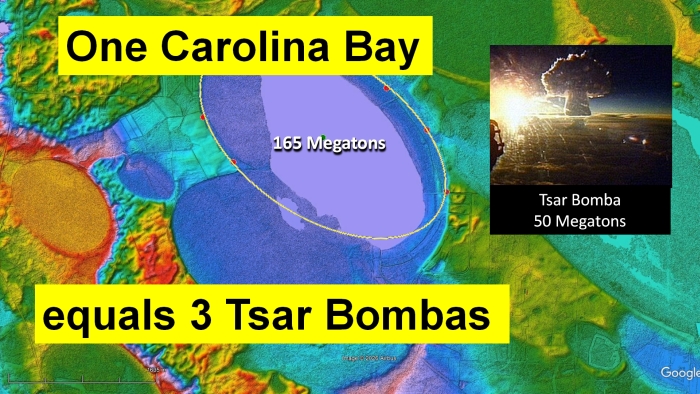
This presentation examines evidence that an extraterrestrial impact on the Laurentide Ice Sheet ejected a uniform distribution of glacier ice debris near Fayetteville, North Carolina. The energy of just one secondary impact is three times greater than the energy of the Tsar Bomba.
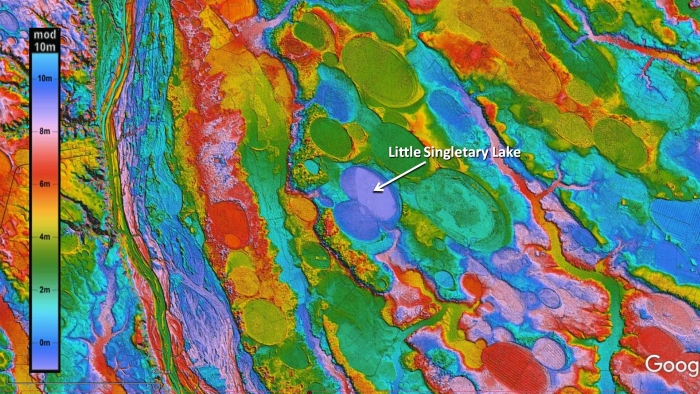
We start by getting familiar with the neighborhood of Little Singletary Lake, which is about 30 kilometers southeast of Fayetteville, North Carolina. This image uses the LiDAR visualization tool for Google Earth by Michael Davias.
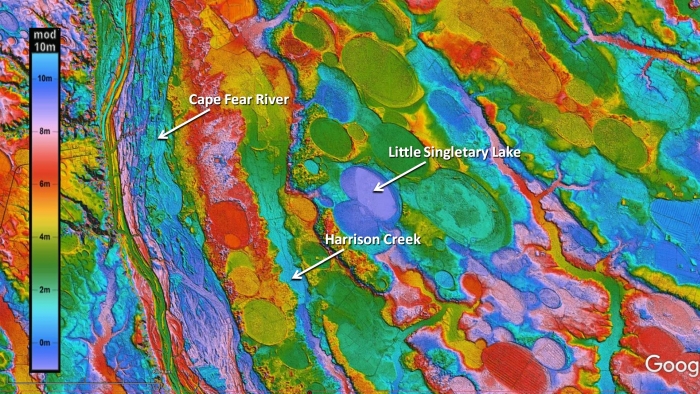
The Cape Fear River and Harrison Creek are located to the west of Little Singletary Lake.
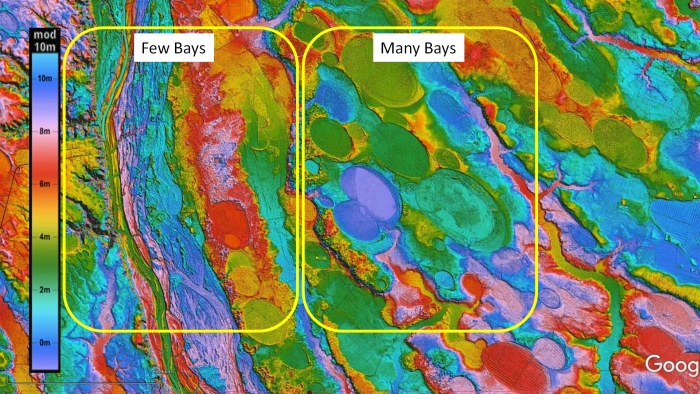
One of the first things that we notice is that the area with the river has just a few bays on the high ground between the river and the creek, whereas the area to the east of the river has many Carolina Bays.
The lack of bays along the fluvial channels brings up the question of whether all the surface was bombarded equally by the glacier ice boulders ejected by the extraterrestrial impact on the Laurentide Ice Sheet. The ejecta curtain from the extraterrestrial impact would have deposited a fairly uniform distribution of ice projectiles in the area of 20 by 30 kilometers represented by this image. The Carolina Bays are fragile sandy structures that are easily eroded by horizontal water flow, so we have to conclude that the Cape Fear River with all its meanders and the Harrison Creek destroyed most of the Carolina Bays that were made in this part of the landscape.
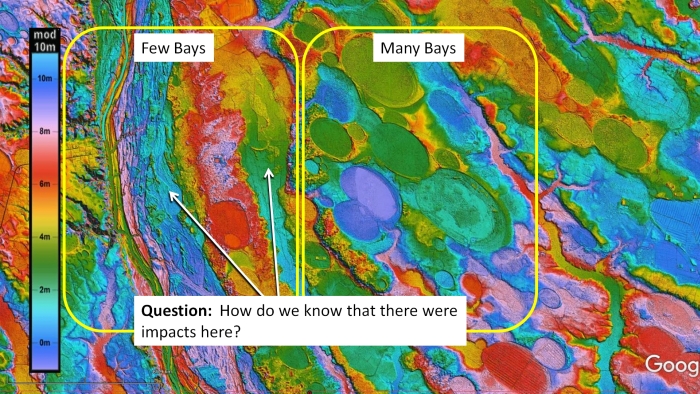
One thing is to be able to deduce that there were impacts along the Cape Fear River and another is to be able to prove it. So, how do we know that there were impacts on the Cape Fear River and Harrison Creek? There is a clue in the splashes of river sediment.
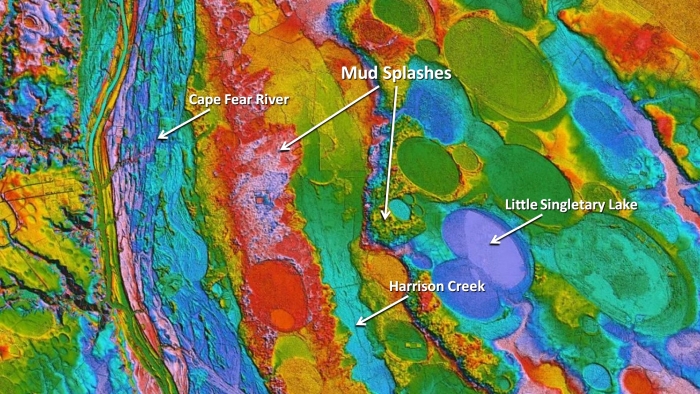
In this enlarged image, we see the mud splashes that were created when sediment from the river and the creek was carried to higher terrain by the strong winds that accompanied the formation of the bays. The impact of an ice projectile on a river bed dredges the sediment and splashes it on higher terrain as illustrated here. Notice that the splashes are to the east side of the river and creek because the wind was blowing in a northeasterly direction.
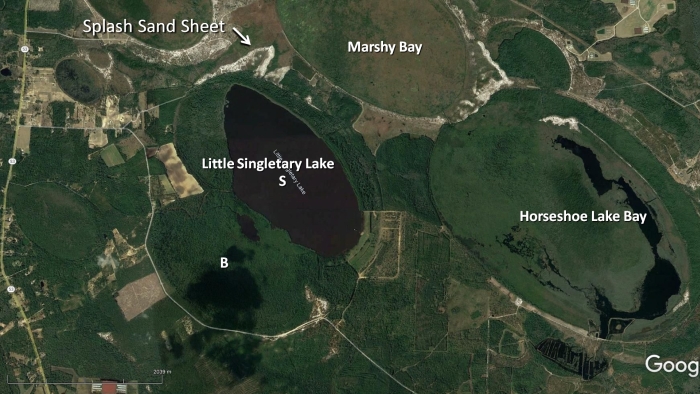
Little Singletary Lake also has a splash sand sheet. This is probably from a small lake that was hit by the glacier ice boulder that made the basin. The sand sheets can be seen more clearly in the satellite image because the white sand of the splash contrasts against the darker background of the surface.
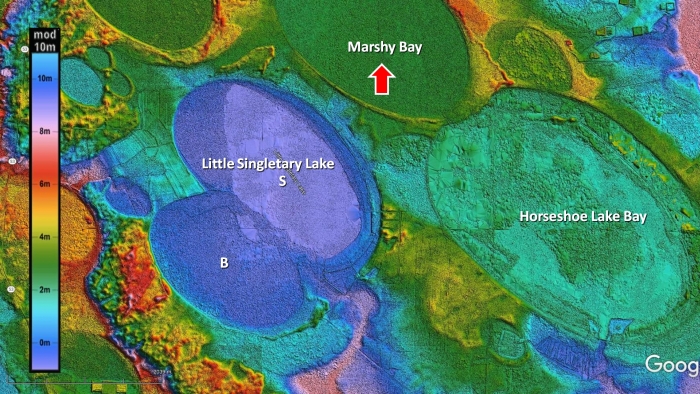
Marshy Bay, which is to the northeast of Little Singletary Lake, has attracted the attention of scientists because it overlays several of the Carolina Bays that surround it.
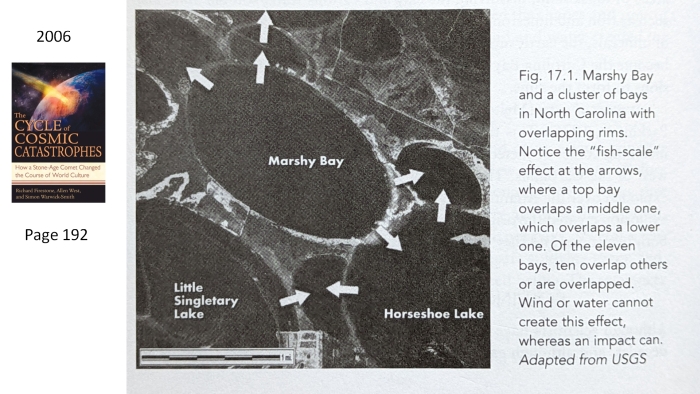
In 2006, the book by Richard Firestone, Allen West and Simon Warwick-Smith introduced the Younger Dryas Impact Hypothesis and brought attention to Marshy Bay and a cluster of bays in North Carolina with overlapping rims. The book says: "Notice the fish-scale effect at the arrows, where a top bay overlaps a middle one, which overlaps a lower one. Of the eleven bays, ten overlap others or are overlapped. Wind or water cannot create this effect, whereas an impact can."
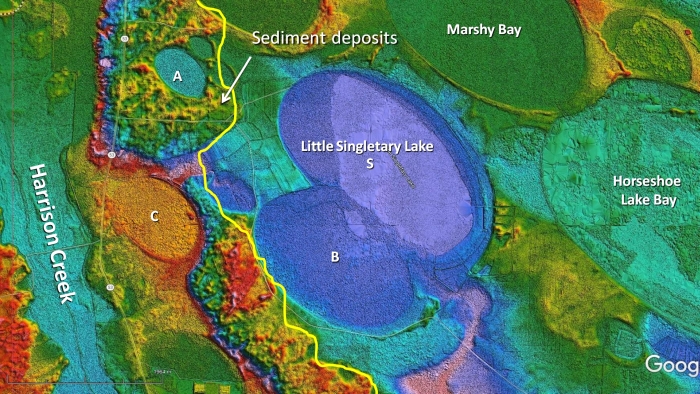
This image highlights the sediment deposits made by the splashes of impacts on Harrison Creek. The deposits cover a strip of land almost two kilometers wide along the bank of the creek. These splash deposits are evidence of the bombardment by ice projectiles on the creek.
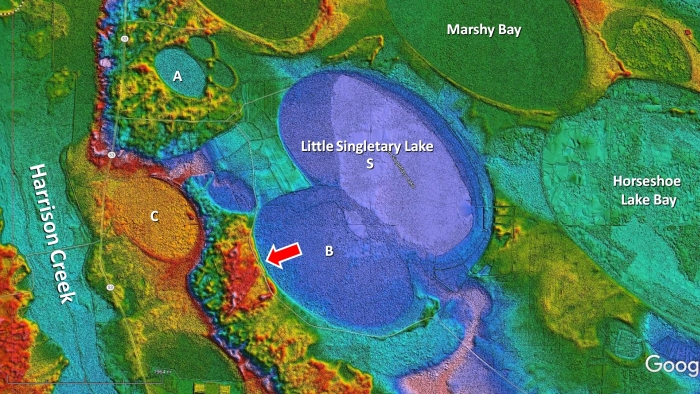
Note that the bays labeled A, B and C cut neatly into the splashed sediment. This means that these bays were emplaced after the splashes were deposited. In the case of bay B we can see that the sand deposits stop abruptly at the margin of the bay, which confirms the deposition sequence. The sand sheet was deposited first and then an impact made bay B, according to the law of superposition.
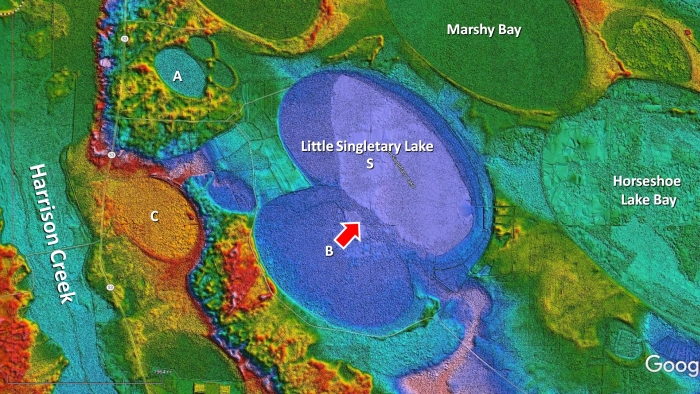
We can also see that the Little Singletary Lake basin was made before the bay labeled B because the rim of bay B spilled into Little Singletary Lake.
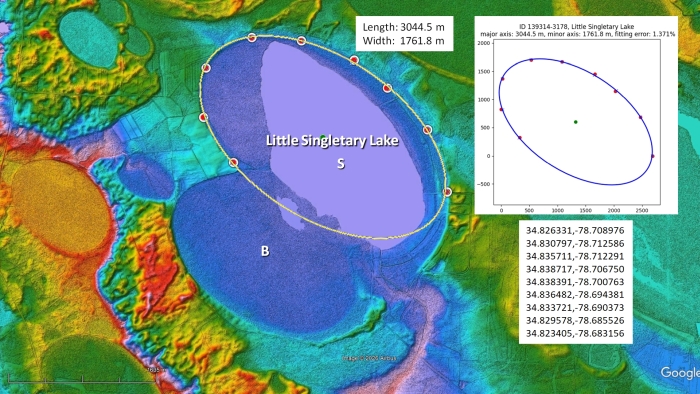
By selecting points along the undisturbed perimeter of Little Singletary Lake and fitting the points with an ellipse by the least squares method, we can show that this Carolina Bay is mathematically elliptical with a fitting error of 1.37 percent. That is a very good fit for a geological feature measuring 3,044 meters in length, which is 1.9 miles.
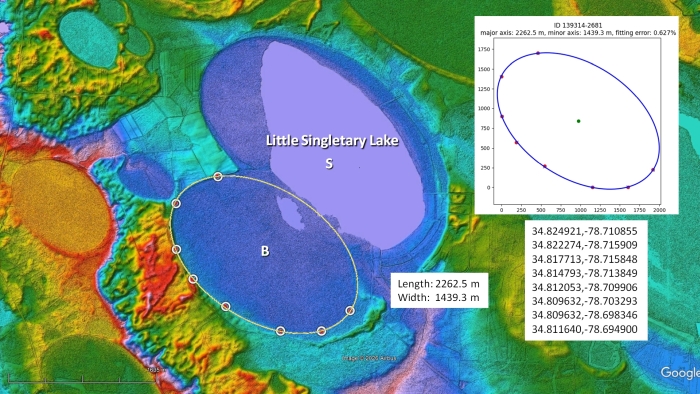
The small bay labeled B conforms to an elliptical shape with an error of only 0.6 percent. The small bay is only small by comparison. It measures 2,262 meters in length, which is 1.4 miles. The Glacier Ice Impact Hypothesis proposes that the Carolina Bays were made by secondary impacts of glacier ice boulders ejected by an extraterrestrial impact on the Laurentide Ice Sheet.
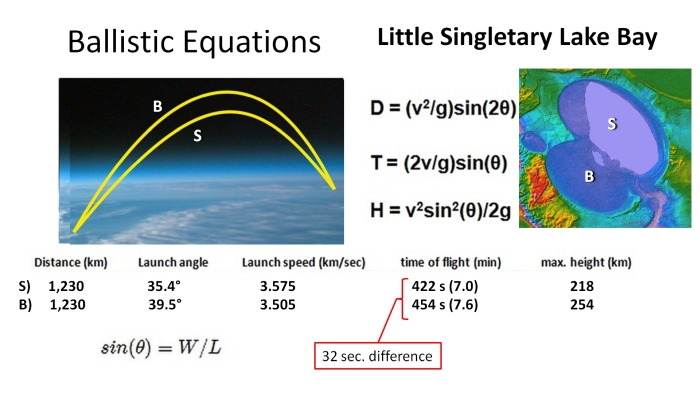
The impact angles obtained from the width-to-length ratios, and the distance of the bays from the convergence point are used to calculate the characteristics of the glacier ice trajectories. The ballistic equations indicate that the ice projectile that made Little Singletary Lake Bay had a flight time of 422 seconds and reached a height of 218 kilometers above the surface of the Earth. The projectile that made the smaller basin had a flight time of 454 seconds and reached a height of 254 kilometers. Both of these trajectories were above Earth's atmosphere in the vacuum of space. From the law of superposition, we know that Little Singletary Lake Bay was created first, and from the ballistic equations we know that the small basin B formed 32 seconds later.
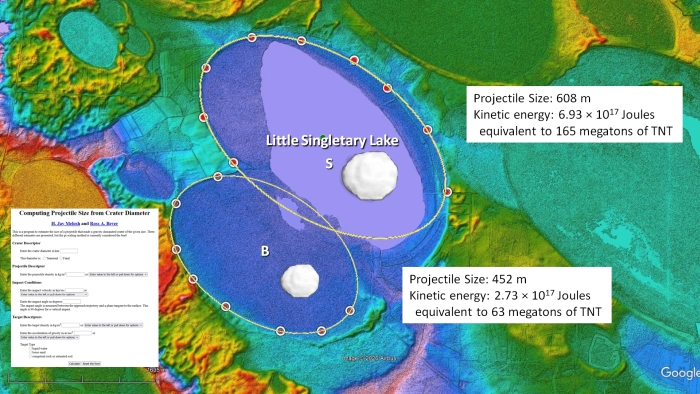
Yield equations correlating crater size with projectile diameter estimate that the ice boulder that made Little Singletary Lake had a diameter of 608 meters and kinetic energy equivalent to 165 megatons of TNT. The smaller bay labeled B was made by an ice projectile measuring 452 meters with kinetic energy equivalent to 63 megatons of TNT. These were huge, powerful impacts that destroyed everything and produced seismic vibrations that liquefied saturated soil. The vibrations promoted viscous relaxation that reduced the depth of the cavities and created the relatively flat centers of the bays.
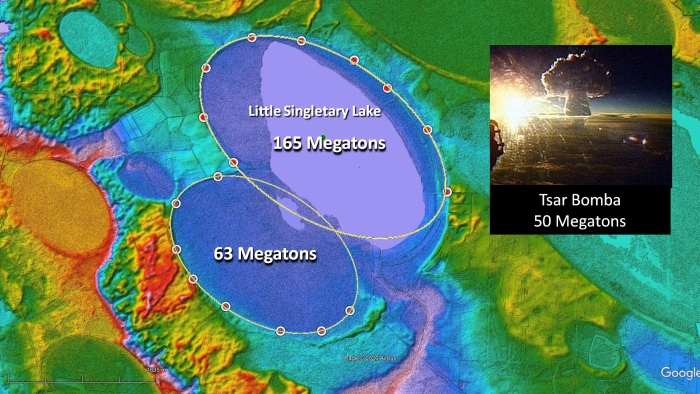
The kinetic energy required to make Little Singletary Lake was 165 megatons of TNT. By comparison, the Tsar Bomba, which was the most powerful nuclear weapon ever created and tested, had a yield of 50 megatons of TNT, which is only about one third of the energy required to create the bay. The energy to create the Carolina Bays and Nebraska Basins from the Rocky mountains to the East Coast was so great that the origin of these basins has to be associated with an extinction event.
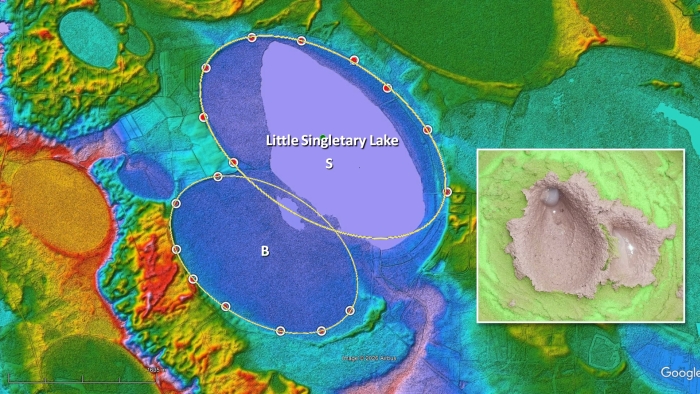
This image shows the degree of overlap of Little Singletary Lake Bay and the smaller bay. The inset shows oblique experimental impacts that produce overlapping patterns similar to these bays and provide support for the impact origin of the Carolina Bays.
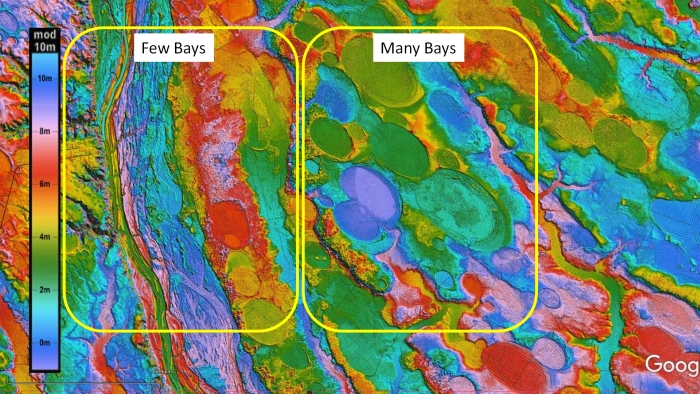
We can conclude with a great degree of certainty that this terrain in North Carolina was uniformly bombarded by glacier ice boulders, but any traces of the impacts in the river and the creek were washed away. Fortunately, we have the splash sand sheets as evidence of the impacts in the river.