The Glacier Ice Impact Hypothesis proposes four mechanisms for the creation of the Carolina Bays and the Nebraska Rainwater Basins. First, one or more extraterrestrial impacts on the Laurentide Ice Sheet by the Great Lakes ejected pieces of glacier ice in ballistic trajectories. The secondary impacts produced seismic vibrations that liquefied unconsolidated soil. The oblique impacts of glacier ice on viscous ground created inclined conical cavities. And finally, the inclined conical cavities, also called penetration funnels, became shallow elliptical basins by viscous relaxation. Mathematically, ellipses are conic sections, so it is logical to propose that the elliptical Carolina Bays originated as inclined conical cavities.
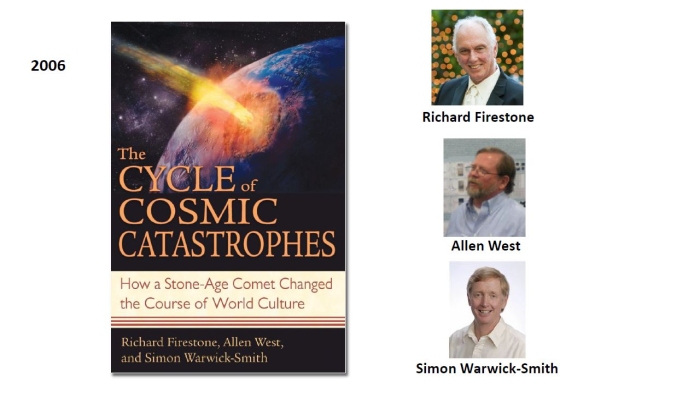
A book published in 2006 by Richard Firestone, Allen West, and Simon Warwick-Smith proposed that a cosmic chain of events culminated in the extinction of the megafauna and the Clovis culture approximately 13,000 years ago. This book established what was later called the Younger Dryas Impact Hypothesis.

Firestone's book proposed that the Carolina Bays were created when a giant dustball comet crashed into the ice of Hudson Bay and the impact blew apart nearly 200,000 cubic miles of the glacier, sending the icy debris hurtling through the air. The lumps of ice crashed into the Carolinas and the eastern seaboard and gouged out the Carolina Bays. The book says that the massive low-flying ice chunks exploded into fireballs. This is chemically and thermodynamically impossible.

A criticism of this book in a paper titled "The Younger Dryas Impact Hypothesis – A requiem" states that in the face of growing contradictory evidence, Younger Dryas impact proponents have presented a range of rapidly changing ad hoc explanations which contradict documented impact processes, contradict each other, and in many cases contradict the laws of physics. Ice chunks exploding into fireballs is an explanation that contradicts the laws of physics. The idea that an impact on an ice sheet could have ejected glacier ice to form the Carolina Bays was also mentioned by Randall Carlson in a 2008 lecture.

"Actual impacts… actual impacts whose effects have been masked by virtue of the fact that they were into a mile- to two mile-thick ice sheet. However, I think that that's going to be the next phase of research into this when we begin to realize that an impact onto an ice sheet, in fact I'm even going to go a little further, I have a new theory now that I'm going to try to figure out how to test, and that is that a major impact of a large object, multi-kilometer object, into the ice sheet may have caused a secondary debris bombardment, which is something that happens normally, except that the debris bombardment may have been actually glacial ice. And that might be something to consider investigating as far as what caused the Carolina Bays. It's the rain down of ice. Yes."

Professor Peter Schultz from Brown University has demonstrated many times that a hypervelocity impact on an ice sheet ejects ice chunks of various sizes in the ejecta curtain. These experiments provide support for the idea that an extraterrestrial impact on the Laurentide Ice Sheet could have ejected pieces of ice in ballistic trajectories to create the Carolina Bays.
Ice is fragile. When an ice projectile hits hard ground, it shatters into many pieces and does not create a noticeable impact cavity. This is due to the fact that sandy ground has a density of 1.5 times greater than ice and hard ground has a density of 3 times greater than ice.
The idea that impacts created the Carolina Bays is not new, but figuring out how the elliptical features were formed requires knowledge about the characteristics of the target materials. Projectile impacts will only produce conical cavities on viscous ground. This experiment shows that the overturned flaps of a penetration funnel become the raised rims of a shallow depression after viscous relaxation.

An ice projectile impacting a viscous medium at an oblique angle creates an inclined conical cavity. Earlier, we saw that an impact on hard ground disintegrates the projectile, but this experiment shows that an impact on a viscous surface allows the projectile to travel through the medium creating a penetration funnel. The resulting conical cavity is elliptical when viewed from above. The overturned flanges become raised rims around the cavity. Experimental impacts can replicate the elliptical morphology with raised rims of the Carolina Bays, and they can also model the overlaps that are frequently seen in the Carolina Bays.
In order to be able to explain the secondary impacts of glacier ice on viscous ground, I first had to figure out how the soil became liquefied. One possibility was to consider that seismic tremors after the extraterrestrial impact were the cause of soil liquefaction. It turns out that most earthquakes of magnitude 6.0 or higher usually liquefy saturated soil. The seismic vibrations mix unconsolidated soil with water and create quicksand slurry that can swallow cars, topple buildings, and break roads as illustrated by the 6.3 earthquake in Christchurch, New Zealand in 2011.

I considered that the seismic vibrations of the extraterrestrial impact could have liquefied the ground a few minutes before the arrival of the ice boulders at the target areas in the Carolinas. However, this was almost impossible to prove because there was no information about the size or the energy of the extraterrestrial impact. There was insufficient data to estimate whether a powerful impact could create seismic waves capable of liquefying soil 1,500 kilometers away. It was necessary to find another way of liquefying the soil.

A publication by Firestone in 2009 proposed that the ice ejecta could have come from Hudson Bay and from the Great Lakes region. The lines in Firestone's paper seemed to be drawn without much regard for accuracy, so they were not very useful.

A map published by Davias in 2010 was more detailed and it had a single epicenter at Saginaw Bay. With this model, it was now possible to determine the distance of any Carolina Bay from its point of origin, and this made it feasible to use ballistic equations to calculate the trajectories of the ice boulders. I used the width-to-length ratio of a Carolina Bay to estimate the angle of impact, and I assumed that this would correspond closely to the launch angle.
Using the distance and the launch angle it was possible to calculate the launch speed. It turned out that the launch speeds for most Carolina Bays were in the range of 3 to 4 kilometers per second. That is really fast. It is about 9 to 12 times the speed of sound. Those ice boulders were really flying out from the impact zone pushed by a plume of steam at high pressure.

The time of flight of the ice projectiles was from six to nine minutes. This means that the horrific bombardment of secondary impacts along the Atlantic Coastal Plain started about six minutes after the extraterrestrial impact by the Great Lakes. That flash of light in the horizon soon became a ferocious hailstorm that darkened the sky and brought death and destruction.
The maximum height reached by the glacier ice boulders was from 150 to about 368 kilometers above the surface of the Earth. The atmosphere only extends to 100 kilometers above the surface, so all these trajectories were suborbital space flights in the vacuum of space. This clarifies why the ice boulders were able to reach the East Coast without totally vaporizing due to air friction. The ballistic analysis also clarifies why Firestone's description of icy debris hurtling through the air was wrong. The ice boulders traveled above the atmosphere and ablation by atmospheric friction only affected the glacier ice boulders during re-entry.

The mystery of the liquefaction of the soil to create a viscous surface was solved using power laws relating energy to crater size. Professor Jay Melosh and Ross Beyer developed a calculator to estimate projectile size from crater diameter. According to the program, a Carolina Bay with a diameter of one kilometer was made by an ice projectile measuring 180 meters in diameter traveling at 3 kilometers per second. This ice projectile would be as big as Yankee Stadium. The kinetic energy of the impact would be 1.27 times 10 to the 16th Joules or 3.03 megatons of TNT. This energy is equivalent to an earthquake of 7.8 magnitude, which provides more than enough seismic vibrations to liquefy unconsolidated soil.

This is a LiDAR image of the Carolina Bays 25 kilometers southwest of Fayetteville, North Carolina. It looks like the surface of the Moon, except that fluvial channels cut through the bays. The impacts that made the bays were so energetic that all this surface was liquefied during the three or four minutes when the ice boulders were hitting the ground. You can see that this was a saturation bombardment. No area was spared. Any animals or plants in this area would have been ground up into a paste indistinguishable from the mud. It is not surprising that there was a megafaunal extinction. All the animals from the Rocky Mountains to the East Coast were killed, but there were survivors beyond the range of the ice boulder bombardment.
Although we have focused on the Carolina Bays, we cannot forget about the Nebraska Rainwater Basins. These geological features have elliptical geometry and raised rims like the Carolina Bays, but they are oriented toward the southwest.

Proponents of the hypothesis that the Carolina Bays were formed by wind and water mechanisms usually do not consider the Nebraska Rainwater Basins. The radial orientation of these elliptical features in the Atlantic Coast and in Nebraska indicates that the source of these impact structures originated in the Great Lakes Region. This is a clue that should not be ignored.
Ellipses are conic sections and the precise elliptical geometry of the Carolina Bays indicates that the bays originated as inclined conical cavities. As we have seen, the Carolina Bays are the most prevalent geological structures in the Atlantic Coastal Plain and they should be in geology books. Once the Carolina Bays are recognized as more than sand dunes, we will learn much more about the history of North America. Thank you for joining me in the exploration of the Carolina Bays. I would like to ask you for a favor. If you see a geology textbook that does not discuss the Carolina Bays, please contact the authors and ask them to correct the omission in their next edition. The Carolina Bays are too important to be ignored.